Mathematics in Reception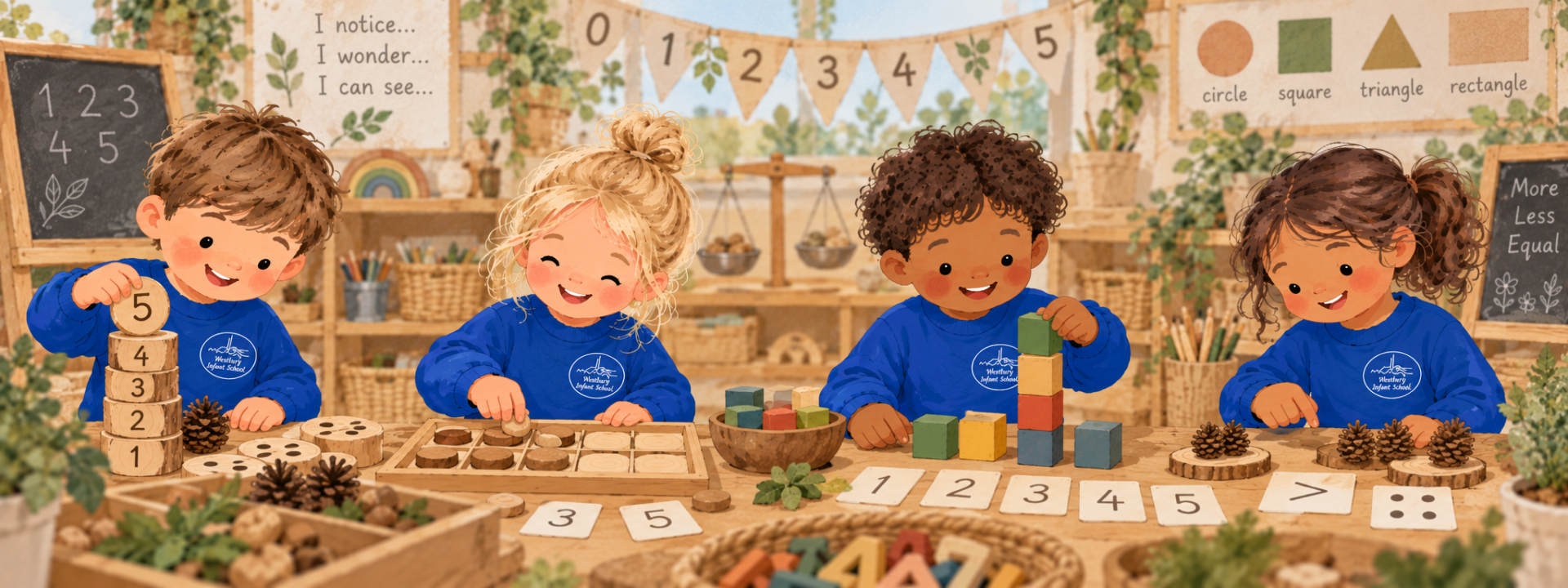
Image created using AI by Westbury Infant School
Mathematics in Reception is practical, playful and full of discovery. Children explore numbers, patterns, shapes and measures through objects, games, stories, songs, conversations and everyday experiences.
We want children to see themselves as confident mathematicians who are curious, willing to have a go and able to explain their ideas.
Rather than simply memorising answers, children develop a deep understanding of how numbers work. They learn to notice relationships, recognise patterns, make comparisons and try different ways to solve a problem.
Our curriculum combines Mastering Number, direct teaching, practical exploration and meaningful opportunities to apply mathematics throughout the learning environment.
What Happens in Reception?
Children experience mathematics through:
- daily Mastering Number sessions;
- practical resources and objects;
- mathematical stories, songs and rhymes;
- visual representations;
- games involving number and pattern;
- construction and block play;
- outdoor learning;
- cooking and measuring;
- routines such as counting and sharing;
- enhancements within the learning environment;
- mathematical conversations; and
- opportunities to investigate and solve problems.
Adults introduce precise mathematical vocabulary and encourage children to explain what they notice and how they know.
Children are given time to explore ideas, make mistakes, try another approach and develop increasingly efficient strategies.
Mastering Number
We use Mastering Number to help children develop a secure and flexible understanding of number.
Through regular sessions, children learn to:
- recognise small quantities without counting;
- count accurately;
- understand that the final number counted tells us how many there are;
- match one number word to each object;
- compare quantities;
- understand how numbers are composed;
- notice relationships between numbers;
- identify one more and one less;
- recall important number facts; and
- explain their mathematical thinking.
Children use practical resources, images, spatial arrangements and mathematical language to explore these ideas.
The emphasis is on understanding. Children are encouraged to see numbers in different ways and explain the relationships they notice.
Subitising
Subitising means recognising how many objects are present without counting each one individually.
For example, children may recognise three dots on a dice immediately rather than counting one, two, three.
Subitising helps children develop a strong sense of number. It supports them to:
- recognise quantities quickly;
- see how a number is arranged;
- understand parts within a whole;
- compare groups;
- notice familiar patterns; and
- calculate more efficiently.
Children explore regular arrangements, such as dice patterns, as well as less familiar arrangements.
Adults may ask:
- “How many can you see?”
- “How did you see them?”
- “Did anyone see it differently?”
- “What parts did you notice?”
These questions show children that the same quantity can be seen and explained in different ways.
Counting and Cardinality
Children learn that counting follows a consistent sequence and that each object should be counted once.
They develop an understanding that:
- number words occur in a fixed order;
- each object receives one count;
- the final number tells us how many objects are in the group;
- objects can be counted in any order;
- the quantity remains the same when objects are rearranged; and
- counting can be used to find out how many.
Children count objects, actions, sounds and movements in meaningful contexts.
They also learn to produce a particular quantity, such as finding six objects rather than simply counting a group that has already been provided.
Number Composition
Composition is the understanding that a number can be made from smaller numbers.
For example, five can be composed of:
- four and one;
- three and two;
- two and three; or
- five and zero.
Children explore number composition using objects, fingers, images, stories and practical situations.
This helps them understand addition and subtraction and provides an important foundation for later calculation.
Children learn to notice parts and wholes, explain how they have arranged a number and recognise that different arrangements can still represent the same total.
Comparing Quantities
Children compare groups and numbers using language such as:
- more;
- fewer;
- less;
- greater;
- smaller;
- equal;
- the same;
- most; and
- least.
They learn that the appearance or size of objects does not determine which group has more.
Children use matching, subitising and counting to compare quantities and explain their decisions.
One More and One Less
Children develop an understanding of how numbers are connected within the counting sequence.
They learn that:
- adding one creates the next number;
- removing one creates the previous number;
- consecutive numbers differ by one; and
- these relationships can be represented using objects, images and number tracks.
Understanding one more and one less supports calculation and helps children develop a connected view of number.
Number Bonds
Children explore how numbers can be combined and separated.
They develop quick recall of important number bonds through:
- practical experiences;
- repeated visual patterns;
- songs and games;
- part-whole representations;
- fingers;
- stories; and
- mathematical discussion.
The focus is on understanding the relationships rather than memorising isolated facts.
Numerical Patterns
Children learn to recognise, describe and continue numerical patterns.
They explore:
- the counting sequence;
- odd and even structures;
- doubles;
- equal groups;
- sharing;
- one more and one less;
- relationships between consecutive numbers; and
- patterns within quantities.
Children use objects and images to explain what they notice.
Adults encourage them to make predictions and test whether their ideas are correct.
Shape and Spatial Reasoning
Children explore shape through construction, puzzles, movement and everyday objects.
They learn to:
- recognise and name familiar shapes;
- describe shape properties;
- notice shapes in the environment;
- compare shapes;
- combine shapes to make new shapes;
- rotate and manipulate shapes;
- complete puzzles;
- copy and create arrangements;
- visualise how shapes fit together; and
- explain position and direction.
Children develop spatial vocabulary such as:
- above;
- below;
- beside;
- between;
- behind;
- in front;
- under;
- over;
- next to;
- through;
- around; and
- turn.
Block play and construction provide especially valuable opportunities to develop spatial reasoning.
Pattern
Children learn to recognise, continue, copy and create repeating patterns.
They explore patterns using:
- objects;
- colours;
- shapes;
- sounds;
- actions;
- movements; and
- natural materials.
Children learn to identify the unit of repeat and explain what comes next.
They also notice patterns that are not repeating, including growing patterns and patterns within the natural environment.
Measure
Children explore measurement through practical comparison rather than formal measuring equipment alone.
They compare:
- length;
- height;
- distance;
- weight;
- capacity;
- size;
- time; and
- duration.
Children use language such as:
- long and short;
- tall and short;
- heavy and light;
- full and empty;
- more and less;
- near and far;
- before and after;
- quick and slow; and
- longer and shorter.
They learn to compare objects directly and use appropriate informal units.
Cooking, water play, construction and outdoor learning provide meaningful contexts for measurement.
Time and Daily Routines
Children develop an understanding of time through familiar events and routines.
They learn to:
- sequence events;
- use words such as before, after, first, next and later;
- recognise parts of the day;
- talk about yesterday, today and tomorrow;
- compare how long activities take; and
- anticipate familiar routines.
They begin to understand that clocks and calendars are tools for measuring and organising time.
Mathematical Problem-Solving
Problem-solving is woven throughout our mathematics curriculum.
Children are encouraged to:
- notice a problem;
- understand what is being asked;
- select suitable resources;
- try an approach;
- explain their thinking;
- check what happened;
- make a change if necessary; and
- consider whether another solution is possible.
Problems may arise through stories, games, construction, sharing, routines or enhancements within the environment.
Adults value children’s strategies and ask questions that encourage thinking rather than immediately providing an answer.
Mathematics Within Play
Purposeful play gives children natural reasons to use mathematics.
Children may:
- count items in a shop;
- share food in a home corner;
- compare the height of towers;
- create repeating patterns;
- measure ingredients;
- organise objects by size;
- use positional language when building;
- record scores;
- follow or create maps;
- estimate how many objects will fit in a container; or
- solve a problem within an imagined situation.
Adults observe carefully and introduce questions, vocabulary or resources that deepen the mathematics without taking over the play.
Our Vision and Values
Mathematics provides many opportunities for children to live out our school vision and values.
Children belong when their ideas and different ways of solving problems are valued.
They thrive when they develop confidence and enjoyment in mathematics.
They achieve when they build secure understanding and apply it in new situations.
They play as they explore number, shape, pattern and measure through meaningful experiences.
Children show respect by listening to different mathematical explanations.
They develop friendship and teamwork by playing games, sharing resources and solving problems together.
They demonstrate resilience when an answer is not immediately obvious and they try another approach.
They work towards excellence by explaining their ideas, checking their work and deepening their understanding.
How Mathematics Develops Across the Year
Across Reception, children move from:
- counting familiar sequences towards counting accurately in varied situations;
- counting every object towards recognising small quantities through subitising;
- seeing numbers as single quantities towards understanding their composition;
- comparing groups visually towards using mathematical evidence;
- finding one more or less practically towards recognising number relationships;
- exploring shapes towards describing, combining and manipulating them;
- copying patterns towards identifying the unit of repeat and creating their own;
- using everyday comparison words towards applying increasingly precise mathematical vocabulary;
- exploring measure informally towards comparing and explaining measurements;
- responding to adult questions towards explaining their own observations and strategies;
- trying one approach towards adapting their thinking; and
- using mathematics with support towards applying it independently in practical problems.
Children develop at different rates. Teaching, resources and support are matched carefully to each child’s current understanding.
How Can Families Help at Home?
Counting and Number
- Count steps, toys, items of clothing or pieces of fruit.
- Ask your child to give you a particular number of objects.
- Count actions such as claps or jumps.
- Notice numbers on doors, buses and signs.
- Play simple board games.
- Use dice, dominoes and number cards.
- Sing number songs.
- Ask, “How many?” and “How do you know?”
Subitising and Composition
- Play briefly showing a small group of objects and hiding them again.
- Use dice and dominoes to recognise quantities.
- Ask how your child saw the number.
- Arrange the same number of objects in different ways.
- Explore different ways to make a number.
- Use fingers to show parts of a number.
- Share snacks and discuss how many each person has.
Shape and Spatial Reasoning
- Build with blocks or construction toys.
- Complete puzzles together.
- Look for shapes in the environment.
- Talk about how shapes can be turned or combined.
- Follow instructions involving position and direction.
- Draw simple maps.
- Give directions during a walk.
- Ask your child to explain how they built something.
Pattern
- Look for patterns in clothing, buildings and nature.
- Create patterns using objects or colours.
- Clap or tap repeating rhythms.
- Make movement patterns.
- Ask what comes next and why.
- Create a deliberate mistake and ask your child to spot it.
Measure
- Compare which object is longer, taller, heavier or lighter.
- Cook together and measure ingredients.
- Explore capacity during water play or bath time.
- Order objects by size.
- Talk about which journey or activity takes longer.
- Use everyday language about time and sequence.
- Estimate before checking.
Problem-Solving
- Ask your child how they worked something out.
- Encourage them to try another way.
- Give time to think before offering help.
- Use practical objects when a problem is difficult.
- Celebrate effort and explanation, not only correct answers.
- Talk positively about mistakes.
- Ask whether there might be more than one solution.
Formal worksheets are not necessary. Mathematics is most meaningful when children can see, touch, discuss and use it within everyday life.
Our Mathematics Progression Documents
The documents below provide more detail about the knowledge and skills taught throughout Reception.
Visit the Maths Curriculum Page for more information
https://www.westbury-inf.wilts.sch.uk/Maths/
Talk to Us
Please speak to your child’s class teacher if you would like advice about supporting mathematics at home or have questions about your child’s progress.
By working together, we can help children become confident, curious and resilient mathematicians.