Literacy in Reception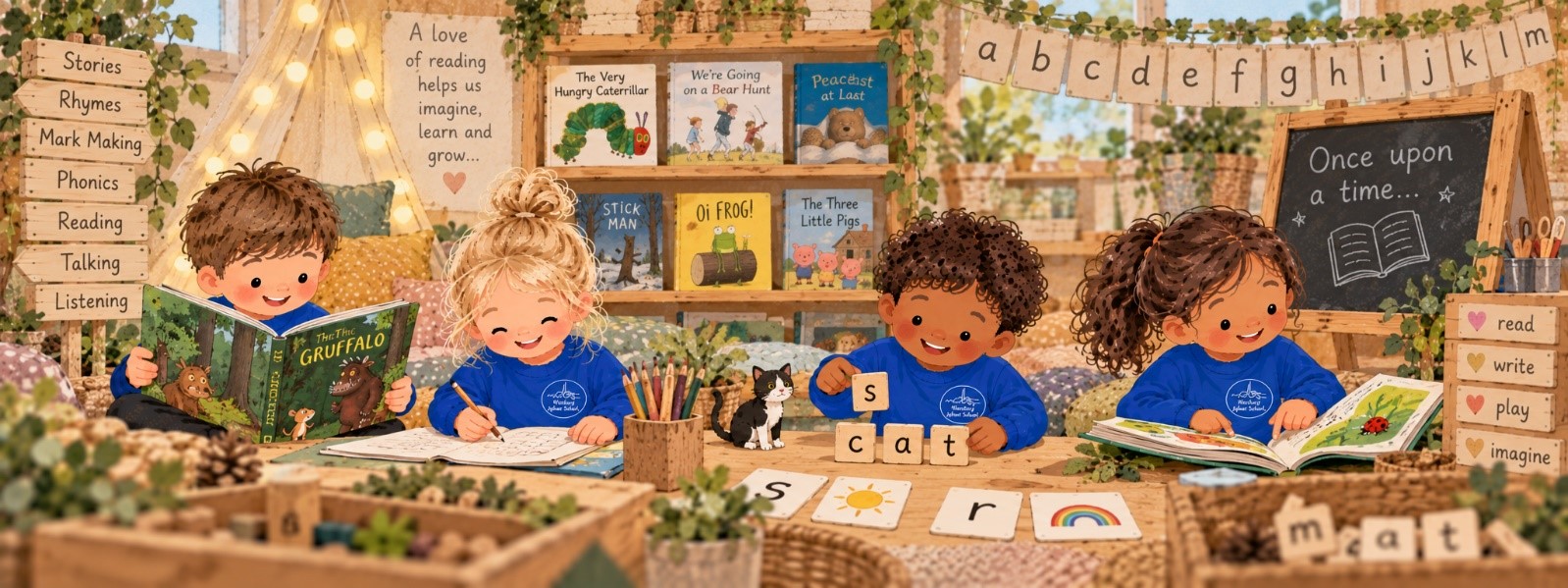
Image created using AI by Westbury Infant School
In Reception, every child begins an exciting journey as a reader, writer and storyteller. Children discover that books can take them to new places, introduce them to fascinating people and creatures, make them laugh and help them understand the world around them.
As children learn how letters and sounds work together, they experience the excitement of reading words and books for themselves. They also discover that their own ideas matter and can be brought to life through talk, drawing and writing.
Literacy in Reception includes comprehension, word reading and writing. These elements are closely connected. Talking about a story develops the language children need for writing, while phonics gives them the tools to read and record their ideas.
Through engaging stories, daily Read Write Inc. teaching, purposeful writing opportunities and imaginative experiences, we help children become enthusiastic readers, confident communicators and proud young writers.
What Happens in Reception?
Children enjoy a rich range of stories, poems, rhymes and information books throughout the year.
Through regular shared reading and discussion, children learn to:
- listen and respond to stories;
- talk about characters, settings and events;
- retell familiar stories;
- predict what might happen next;
- sequence events;
- learn and use new vocabulary;
- ask and answer questions;
- make connections with their own experiences; and
- explain their ideas about what has been read.
High-quality books are carefully selected to support our curriculum. These texts help children develop vocabulary, encounter new ideas and learn more about themselves and the wider world.
Our values are reflected throughout Literacy. Children demonstrate respect by listening to different ideas, friendship and teamwork by sharing and creating stories together, and resilience as they practise new reading and writing skills.
Read Write Inc. Phonics
We use Read Write Inc. Phonics to teach children to read and write systematically.
Children take part in daily Read Write Inc. sessions. They learn to:
- recognise the sounds represented by letters and groups of letters;
- pronounce sounds clearly;
- blend sounds together to read words;
- segment spoken words into sounds for spelling;
- read common words;
- read sentences and short texts;
- form letters correctly; and
- develop accuracy, fluency and confidence.
Children are grouped according to their current stage of reading development so that teaching can be closely matched to their needs. Their progress is assessed regularly, and additional support is provided when necessary.
The books children read independently are closely matched to the sounds they have already learned. This helps them experience success and develop confidence.
Children reread familiar books because repeated reading helps improve their accuracy, fluency, understanding and expression.
Reading for Pleasure
Learning to decode words is only one part of becoming a reader. We also want children to develop a genuine enjoyment of books.
Children have regular opportunities to:
- listen to adults reading aloud;
- choose and share books;
- revisit favourite stories;
- explore poems, rhymes and information texts;
- recommend books to others;
- talk about their favourite characters and events; and
- enjoy books independently and with friends.
Adults read books that may be beyond the children’s current independent reading ability. This allows children to experience ambitious vocabulary, more complex stories and a wider range of ideas.
Poetry Basket
We use Poetry Basket to help children develop a love of poetry, rhythm and language.
Children learn and perform a carefully selected collection of poems throughout the year. Through regularly revisiting these poems, they develop:
- listening and attention;
- confidence when speaking;
- an awareness of rhythm and rhyme;
- clear expression and intonation;
- new vocabulary;
- memory and recall; and
- enjoyment of words and language.
Actions and repeated phrases help children join in and remember each poem. Performing together also develops friendship, teamwork and confidence.
Families can help by enjoying the poems together at home and encouraging children to perform their favourites.
Helicopter Stories
We use Helicopter Stories to celebrate children’s ideas and develop their confidence as storytellers.
Children tell their own stories to an adult, who writes down their words. The story is then shared with the class and acted out by the children.
Helicopter Stories helps children:
- recognise that their ideas are important;
- develop characters, settings and events;
- organise ideas into a narrative;
- use increasingly rich vocabulary;
- speak clearly and confidently;
- listen and respond to other people’s ideas;
- use imagination through role play; and
- develop the oral composition needed for writing.
When children act out stories together, they also practise respect, friendship and teamwork by listening, taking turns and contributing to a shared performance.
Developing Transcription Skills
Transcription is the process of turning spoken language into written words. It includes spelling, handwriting and using phonics to record ideas.
Throughout Reception, transcription is taught in a carefully sequenced way. Children learn to:
- hear and identify sounds within spoken words;
- connect sounds with the correct letters;
- segment words into sounds for spelling;
- form letters using the correct movement;
- position letters appropriately on the page;
- leave spaces between words;
- write common words;
- remember a sentence before writing it;
- write words and sentences with increasing fluency; and
- reread their writing to check that it makes sense.
Read Write Inc. provides the phonic knowledge children need for transcription. Regular handwriting, spelling and sentence-writing practice helps these skills become increasingly automatic.
Developing secure transcription skills allows children to concentrate more fully on composing and communicating their own ideas. Children are encouraged to use the sounds and words they know, attempt spellings independently and show resilience when writing feels challenging.
Writing in Reception
Writing develops from children’s speaking, listening, physical development, storytelling and growing knowledge of phonics.
Children are taught how to:
- say aloud what they want to write;
- hold a sentence in their memory;
- listen for sounds within words;
- use their phonic knowledge when spelling;
- form letters correctly;
- separate words with spaces;
- write simple phrases and sentences;
- reread their writing; and
- make changes or add further detail.
Children write for meaningful purposes across the curriculum and within their play. They may create:
- labels;
- lists;
- cards;
- signs;
- messages;
- captions;
- instructions;
- descriptions; and
- stories.
Enhancements within the learning environment provide purposeful reasons to read and write. Adults support children while also encouraging them to develop independence and confidence.
Drawing Club
Drawing Club begins during the summer term, once children have developed a secure foundation of phonic and transcription skills.
Through Drawing Club, children explore stories, develop their own imaginative ideas and use drawing and writing to communicate them.
It provides opportunities for children to:
- develop and talk about their ideas;
- use new vocabulary;
- create characters, settings and adventures;
- apply their phonic knowledge;
- compose their own sentences; and
- experience themselves as confident writers.
Drawing Club builds upon the oral storytelling, phonics, handwriting and writing skills developed throughout the year.
How Literacy Develops Across the Year
Across Reception, children progress from:
- listening and responding to stories towards discussing them in greater detail;
- recognising individual sounds towards blending sounds to read words and sentences;
- reading carefully matched books towards reading with greater fluency and expression;
- joining in with poems and rhymes towards performing them confidently;
- telling simple ideas towards creating and acting out their own stories;
- making marks and writing familiar letters towards writing phrases and sentences;
- hearing sounds within words towards using phonics independently when spelling;
- talking about ideas towards composing and rereading their own writing; and
- relying on adult support towards reading and writing with increasing independence.
Children develop at different rates. Teaching, books and additional support are matched carefully to each child’s current stage.
How Can Families Help at Home?
Sharing Books
- Share a story every day when possible.
- Continue reading to your child even when they begin reading independently.
- Let your child choose books and revisit favourites.
- Talk about the pictures, characters and events.
- Ask what your child thinks might happen next.
- Explain unfamiliar words and encourage your child to use them.
- Visit the local library and choose books together.
Supporting Read Write Inc.
- Listen to your child read the Read Write Inc. books sent home.
- Encourage your child to use the sounds they have learned.
- Reread familiar books to develop fluency and confidence.
- Use the same pronunciation of sounds demonstrated by the school.
- Keep reading sessions short, positive and encouraging.
- Praise effort, concentration and perseverance.
- Avoid introducing unfamiliar phonics methods that may cause confusion.
Enjoying Poetry and Stories
- Encourage your child to perform poems learned through Poetry Basket.
- Join in with actions, repeated phrases, rhyme and rhythm.
- Make up stories together about familiar people, toys or places.
- Invite your child to tell a story while you write down their exact words.
- Act out stories using toys, costumes or everyday objects.
- Celebrate imaginative ideas without worrying about whether a story is realistic.
Encouraging Writing
Provide meaningful opportunities for your child to:
- write a shopping list;
- make a card;
- label a picture or model;
- write a message;
- create signs for a game;
- record scores;
- write about a shared experience; or
- make their own book.
Encourage your child to say the word slowly and listen for the sounds they can hear. Allow them to attempt words independently before offering help.
Support correct letter formation using the approach demonstrated by the school. Celebrate your child’s ideas and effort, recognising that spelling will continue to develop as their phonic knowledge grows.
Our Literacy Progression Documents
The documents below provide more detail about the knowledge and skills taught throughout Reception.
- View our Communication and Language Progression
- View our Literacy Curriculum Progression
- View our Writing Curriculum
- View our Writing Progression
- View our Reading and Phonics Progression
- View our Reading spine
- View our Handwriting Curriculum Progression
Talk to Us
Please speak to your child’s class teacher if you would like advice about reading or writing at home, or if you have questions about your child’s progress.
By working together, we can help children become enthusiastic readers, imaginative storytellers and increasingly confident writers.